
From Vendor to Strategic Partner
How Value-Based Selling Transforms Your Win Rate
There is a ceiling that many B2B sales teams hit — and they rarely see it coming. Deals are being won, revenue is growing, and the team is working hard. But margins are thin, sales cycles are long, and every renewal feels like a fresh fight.
The culprit, in almost every case, is the same: the company is positioned as a vendor rather than a partner.
Vendors are evaluated on price, features, and convenience. Partners are evaluated on impact, trust, and strategic alignment. Vendors compete. Partners advise. Vendors get replaced. Partners get renewed — and expanded. The transition from vendor to strategic partner is not about changing your product. It is about fundamentally changing how your team sells. Specifically, it requires mastering Value-Based Selling (VBS) — a methodology built on one core principle: buyers do not buy products, they buy outcomes. In this post, we break down what Value-Based Selling actually means in practice, the five most common places teams get it wrong, and how to make the shift in a way that sticks.
“Vendors compete on price. Partners compete on impact. The difference is how you sell.”
What Value-Based Selling Actually Means
Value-Based Selling is not a tactic. It is not a script, or a closing technique, or a way to justify a higher price point. It is a sales philosophy that places the buyer’s business outcomes at the centre of every conversation. In practice, it means your team enters every sales interaction having already done the work to understand the buyer’s world — their strategic priorities, their key metrics, their biggest risks, and the cost of inaction on the problem you solve. Rather than presenting a product and its features, your rep presents a diagnosis of the buyer’s situation and positions your solution as the most credible path to the outcome they care about.
The difference in how this lands with a decision-maker is profound. Feature pitches create comparison. Outcome conversations create conviction.
Mistake 1: Leading with the Product
The single most common way teams fail at VBS is opening with what they sell rather than why the buyer should care.
‘Let me show you our platform’ is vendor language. ‘Based on what you shared about your Q4 targets, here is what we are seeing in companies at your stage’ is partner language. The first triggers a price comparison. The second triggers a strategic conversation.
The Fix: Train your team to open every pitch with an insight about the buyer’s situation — ideally one they have not considered themselves. Provocation before presentation is the hallmark of elite salespeople.
Mistake 2: Ignoring the Economic Buyer
Value-Based Selling requires access to the person who feels the financial consequence of the problem you solve. Yet most sales teams spend the majority of their time with operational contacts — managers, analysts, and team leads — who have influence but not authority.
When the economic buyer is not in the room, your champion has to translate your value proposition without your help. And in that translation, the strategic impact almost always gets lost — leaving your solution looking like a line-item cost rather than a revenue driver.
The Fix: Map every deal to the economic buyer early. Use your champion to build the internal business case — and equip them with the ROI data, the executive framing, and the risk quantification they need to make that case convincingly upward.
Mistake 3: Skipping Quantification
Saying your product will ‘improve efficiency’ or ‘accelerate growth’ is not value-based selling. It is vague assertion — and decision-makers have heard it from every vendor they have spoken to this quarter. Real value is quantified. It is the number of hours saved per week, multiplied by loaded labour cost. It is the percentage increase in deal close rate, translated into incremental revenue. It is the cost of a compliance failure your product prevents.
When you can put a number on the outcome, your solution stops being an expense and becomes an investment with a calculable return.
The Fix: Build a simple ROI calculator specific to your buyer’s industry and deal size. Use it in every late-stage conversation. Make the cost of inaction visceral and specific — not abstract.
Mistake 4: Competing on Features
If your prospect is asking you to compare features against a competitor, you have already lost the value conversation. Feature comparison is vendor territory. It commoditises your solution and hands pricing control to the buyer. Strategic partners do not compete on feature lists. They compete on fit — their understanding of the buyer’s specific context, their track record with similar organisations, and their ability to deliver a defined outcome reliably.
The Fix: When a prospect pushes for a feature comparison, redirect the conversation to outcomes. Ask: ‘If we could guarantee you achieve outcome X in Y timeframe, would that be worth prioritising over feature Z?’ Reframe the decision from ‘which product has more’ to ‘which partner gives us the highest confidence.’
“Feature comparison is vendor territory. Strategic partners compete on fit, confidence, and outcomes.”
Mistake 5: Treating Every Buyer the Same
Value is not universal — it is contextual. A CFO cares about margin impact and risk mitigation. A COO cares about operational efficiency and scalability. A Sales Director cares about quota attainment and rep productivity. The same solution delivers different value to each of these personas. Sales teams that lead with the same pitch regardless of who they are speaking to will resonate with nobody.
The Fix: Build persona-specific value maps for your top three to four buyer types. For each persona, document their primary business objective, the key metric they are measured on, the risk they most want to avoid, and the specific outcome your solution delivers in their language.
The Shift in Practice: What Changes
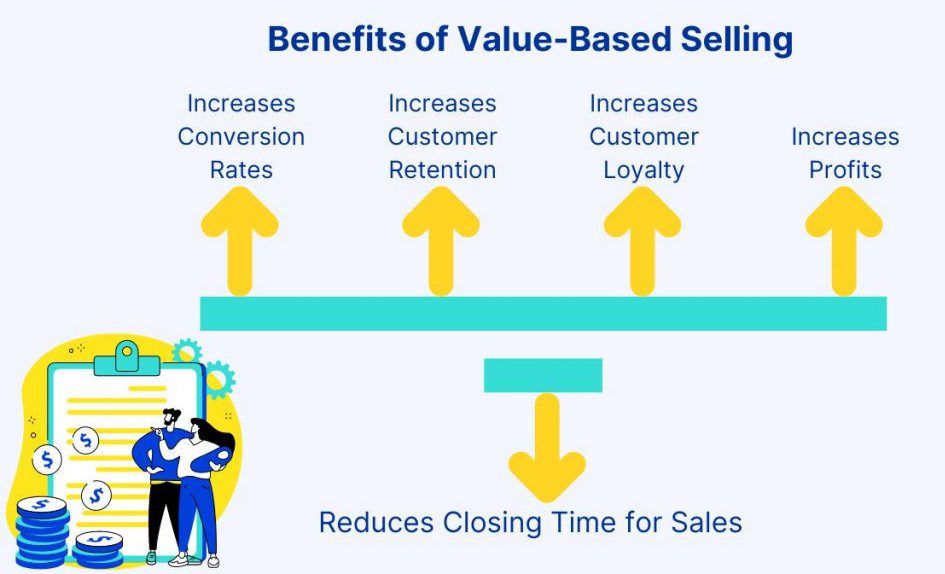
When a sales team makes the transition to Value-Based Selling, several things change immediately and measurably:
- Average deal size increases, because conversations happen at the strategic level rather than the procurement level.
- Sales cycles shorten, because buyers who understand the cost of inaction are motivated to act, rather than defer.
- Discounting drops, because price objections are replaced by ROI conversations.
- Renewals become easier, because the customer bought an outcome — and if the outcome was delivered, the renewal decision is simple.
The transition does not happen overnight. It requires new skills, new tools, and new habits — and consistent coaching to reinforce them. But the commercial upside of making this shift is, in our experience, one of the highest-return investments a growing sales team can make.
Ready to Shift from Vendor to Strategic Partner?
We help B2B sales teams adopt Value-Based Selling frameworks that increase deal size, reduce discounting, and build lasting client relationships.
👉 Book Your Free Strategy Call at bluecircleinnovations.com